How Homeopathy Works: Explained in Simple Terms
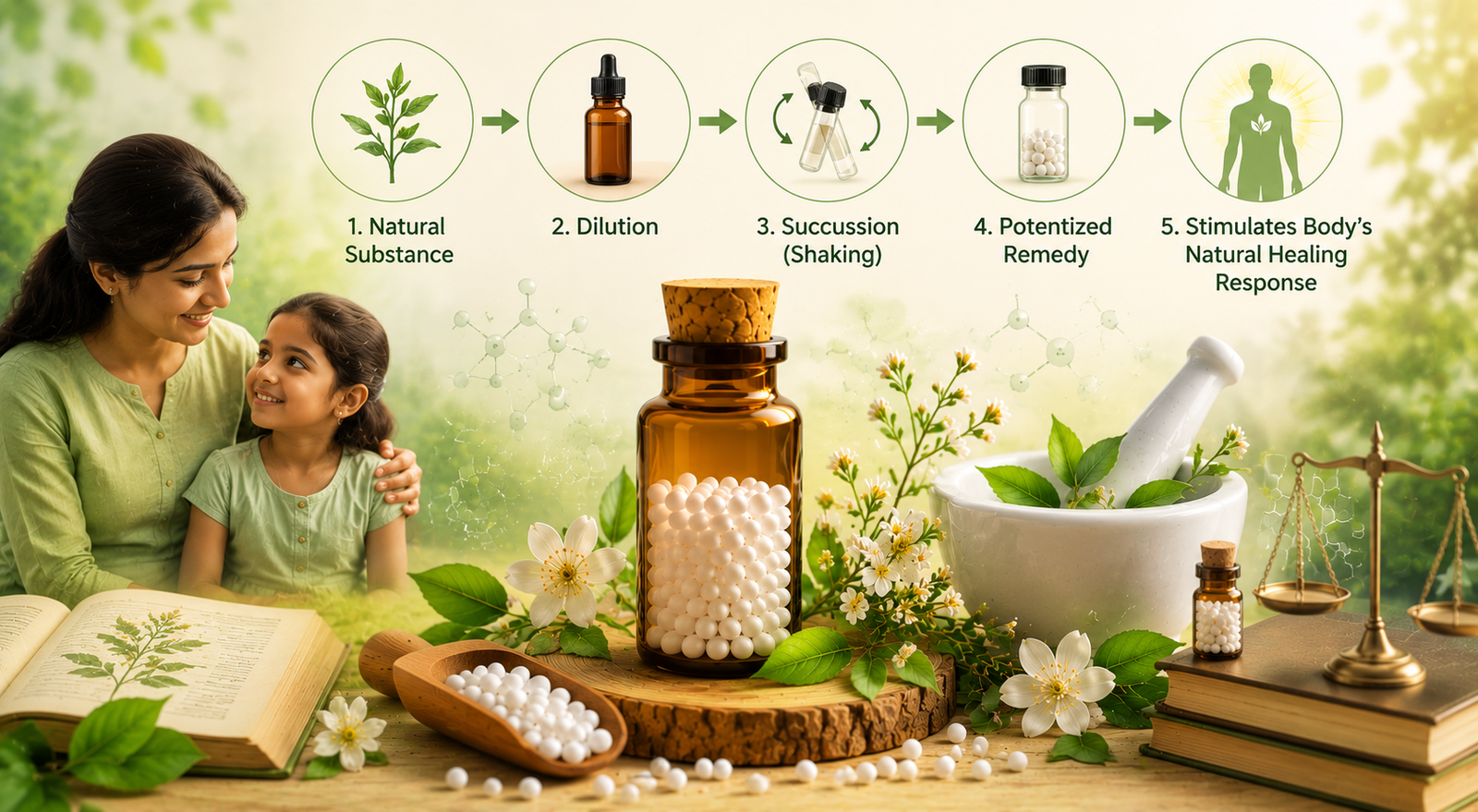
Homeopathy works on two core ideas: first, that "like cures like" — a substance that causes symptoms in a healthy person can cure similar symptoms in a sick one; and second, that the more a medicine is diluted and energised through a process called potentization, the more powerful its healing effect becomes. Rather than suppressing your symptoms, homeopathy stimulates your body's own intelligence to heal itself from the root.
If you have ever been handed a small bottle of sweet white pills and wondered what exactly is in it, and how does it work — you are not alone. Homeopathy is one of the most widely used medical systems in India, trusted by over 100 million people, and yet its core principles remain a mystery to most of the people who use it. This guide breaks it all down in plain language that anyone can understand.
First: What Is Homeopathy, Actually?
Homeopathy is a complete system of medicine developed over 200 years ago by a German physician named Samuel Hahnemann. Frustrated with the harsh treatments of his era, Hahnemann began experimenting with gentler approaches to healing. His central discovery: the body has a remarkable capacity to heal itself. The job of medicine, he believed, is not to take over and fight the disease for you — but to give your body the precise signal it needs to mount its own healing response.
The First Law: Like Cures Like
This is the foundational idea of all homeopathic practice. Think about cutting an onion. When you cut a raw onion, your eyes water, your nose runs, and you get a burning, irritating sensation. These are specific, recognisable symptoms. Now: one of the most commonly used homeopathic remedies for hay fever and cold allergies — conditions marked by watery eyes, runny nose, and burning irritation — is Allium cepa, made from red onion.
Another everyday example: coffee causes nervousness, racing thoughts, palpitations, and insomnia in sensitive people. The homeopathic remedy Coffea cruda, made from coffee, is one of the classical remedies for exactly those symptoms — including sleeplessness from an overactive mind. This principle — the Law of Similars — goes back even to Hippocrates. Hahnemann gave it a systematic, clinically verifiable form.
The Second Law: The More Diluted, The More Potent
This is the idea that surprises most people — and admittedly, it goes against conventional pharmaceutical logic. In standard medicine, higher dose equals stronger effect. In homeopathy, the opposite is true: the more a substance is diluted and energised through a special process, the more powerful its therapeutic effect. This process is called potentization.
How Potentization Works
- Step 1 — The Mother Tincture: the healing substance (a plant, mineral, or other natural source) is dissolved in alcohol or water to create the starting preparation
- Step 2 — Dilution: one part of the mother tincture is added to 99 parts of water or alcohol (for C potencies) or 9 parts (for X potencies)
- Step 3 — Succussion: after each dilution, the solution is vigorously shaken — struck firmly against a hard surface dozens of times. Dilution without succussion does not produce a healing effect
- Step 4 — Repeat: this dilute-and-shake cycle is repeated multiple times. A 6C remedy has gone through this process 6 times; a 30C remedy, 30 times
What Do the Numbers Mean on the Bottle?
If you have seen labels like Arnica 30C or Belladonna 200C, here is what they mean: the letter tells you the dilution scale (C = centesimal, 1 in 100 each step; X = decimal, 1 in 10 each step), and the number tells you how many times that dilution-and-shaking cycle was repeated. So 30C means the original substance was diluted 1:100 and shaken, thirty times in sequence.
The Third Principle: Treat the Person, Not the Disease
This is where homeopathy differs most dramatically from conventional medicine. In allopathic medicine, two people with the same diagnosis get broadly the same treatment. In homeopathy, no two patients are ever treated identically, even if they have the same diagnosed condition. A homeopathic doctor looks at your entire picture:
- What are your specific symptoms — not just "headache" but where exactly, what kind of pain, what makes it better or worse, what time of day
- What is your mental and emotional state — are you anxious, irritable, withdrawn, weepy, fearful
- What are your physical characteristics — do you feel hot or cold, what foods do you crave or hate, how do you sleep
- What is your life history — past illnesses, surgeries, grief, trauma, family patterns of disease
From this complete picture — called the totality of symptoms — the homeopathic doctor identifies the single remedy whose known symptom profile most closely matches yours. This is your simillimum — the most similar medicine for you, at this moment.
Why Does Homeopathy Work Slowly for Chronic Conditions?
Chronic diseases take years — sometimes decades — to develop. They are the result of accumulated imbalances at a deep constitutional level. Homeopathy aims to reverse that process — not just suppress the surface symptoms. Acute conditions like cold, fever, or diarrhoea often respond within hours to days. Chronic conditions like eczema, psoriasis, thyroid disorders, or PCOD may require weeks to months of treatment — but the healing is deep and lasting.
During this process, patients often notice their general wellbeing improving first — better sleep, better energy, improved mood — before the specific condition begins to resolve. This is considered a positive sign that the remedy is working at the constitutional level.
What Conditions Does Homeopathy Work Best For?
Homeopathy shows particular strength in:
- Chronic skin disorders — psoriasis, eczema, urticaria, acne, vitiligo
- Hormonal and reproductive health — PCOD, irregular periods, thyroid disorders, menopause
- Respiratory conditions — asthma, recurrent colds, allergic rhinitis, sinusitis
- Digestive disorders — IBS, chronic acidity, colitis
- Joint and musculoskeletal issues — arthritis, gout, back pain
- Mental and emotional health — anxiety, depression, insomnia, grief
- Paediatric conditions — recurrent infections, behavioural concerns, allergies
For acute emergencies — trauma, surgical emergencies, life-threatening infections — allopathic intervention is essential. Homeopathy and modern medicine are not enemies; they are complementary systems. At Shree Radhey Care, every patient receives a detailed, personal case analysis by the same qualified doctor from start to finish, with doorstep delivery of medicines anywhere in India.
Summary: How Homeopathy Works in 5 Points
- Like cures like — a substance that causes symptoms in a healthy person can cure those symptoms in a sick one
- Potentization — dilution combined with vigorous shaking creates a remedy that works energetically, not chemically
- Individualisation — two people with the same disease get different remedies based on their unique symptom picture
- Stimulates the body's own healing — rather than suppressing symptoms, homeopathy prompts your body to complete its healing work
- Treats the root, not just the surface — which is why deep, lasting results in chronic conditions take time but are more complete
Frequently Asked Questions
What is the basic principle of homeopathy?
Homeopathy is based on two core laws: the Law of Similars ("like cures like") and the Law of Infinitesimals (that extreme dilution combined with succussion increases a remedy's potency).
How are homeopathic remedies made?
Homeopathic remedies are made through potentization — repeated cycles of dilution (typically 1:100 for C potencies) followed by vigorous shaking called succussion. The liquid is then often impregnated into small sugar pellets.
How long does it take for homeopathy to work?
Acute conditions may respond within hours to a few days. Chronic conditions typically require weeks to months of treatment, as homeopathy works to reverse deep-seated imbalances rather than simply suppress symptoms.
Can homeopathy treat chronic disease permanently?
Homeopathy aims to treat the root constitutional cause of disease. When the correct individualised remedy is found and followed through, many patients experience long-term relief and, in some cases, complete resolution of chronic conditions that conventional medicine could only manage.